21 May 2025
Vice Chairman of State Admini-stration Council Deputy Prime Minister Vice-Senior General Soe Win, accompanied by Yan-gon Region Chief Minister U Soe Thein, senior military officers from the Office of the Com-mander-in-Chief, the Yangon Command commander and officials, inspected Taikkyi farm-ing zone under construction and Yangon Command multiple farming and agriculture camps in Yangon Region this afternoon.
On arrival at the zone, the Vice-Senior General and party heard a report on points of a meeting with authorized entrepreneurs of the zone and de-partmental personnel of Taik-kyi Township, salient points of the area, formation of Taikkyi farming zone steering commit-tee, types and number of animals authorized companies are going to raise in the zone, ongoing farming activities in the zone, and endeavours for building roads and installing powerlines and water supply system, pre-sented by the chief minister.
In response, the Vice-Senior General asked for more infor-mation and gave guidance. He said the SAC has adopted two political goals and two national goals. It is implementing the two national goals – national prosperity and food sufficiency – till success is achieved. The zone must be successfully im-plemented to ensure local food sufficiency as a way. Yangon Region has a population of over 7.3 million, and it has to rely on food produced from other regions and states because it cannot produce enough food for its residents. The Prime Minister has given guidance to systematically extend agricul-ture and farming zones for en-suring food sufficiency for the local people. Hence, the zone must be implemented part by part according year-wise plans for it to export food, apart from enabling the region to produce adequate amount of food for its people.
Business owners who plan to invest in the livestock breeding zone are encouraged to work in collaboration with relevant departmental staff, who should provide necessary support, advice, and assistance to ensure smooth and efficient operation of livestock businesses. In addi-tion, authorities responsible for animal health should collectively implement disease preven-tion measures for the animals. Since this involves livestock breeding, biosecurity measures are of primary importance. Infectious diseases can spread due to uncontrolled human movement and then transmit from animal to animal, affecting the ecosystem. Therefore, it is necessary to establish and im-plement preventive measures from the early planning stages based on ecosystem knowledge.
In livestock operations, ensur-ing animals receive sufficient and nutritious feed is crucial. There are different breeding systems such as herding, caging and hybrid systems that combine both. Among these, the confined breeding system is considered the most effective. If this system is to be used, it is important to provide daily feed and supplements for the animals. For these supplemen-tary feeds, efforts should be made to consistently cultivate and produce them locally within the breeding zone itself.
It is also important to pro-mptly and fully implement the designated targets within the zone and ensure that no unrela-ted businesses operate within the livestock breeding zone. Relevant authorities must strictly monitor this. Businessper-sons implementing the Taikkyi livestock breeding zone have to emphasize their functions and duties leading to systematic livestock breeding measures.
Water and electricity are the main requirements for farming. It was found that the regional government has provided both. In cases of insufficient electricity, business owners can undertake solar power generation projects.In addition, beginning this rainy season, fast-growing trees must be planted in a three-row zigzag pattern in respective yards, as instructed by the Prime Minister.Planting trees in this manner can provide effective protec-tion for animals and buildings against natural disasters.To establish the Taikkyi farming zone as a model farming area, it is essential to develop detailed plans for each activity based on a defined timeline and implement them without delay.
If capital is required to carry out activities within the zone, funding sources such as the regional government’s non-repayable grants, MSME loans, and national economic develop-ment funds may be utilized. Loans must be repaid regularly within the specified timeframe.
He emphasized that everyone must work together with un-wavering determination, dili-gence, and effort to ensure the Taikkyi farming zone progresses and achieves success at a competitive level with in-ternational standards.
Then, the Vice-Senior General and members inspected the construction sites of relevant companies, including poultry farms and other facilities for livestock operations in the Taik-kyi farming zone.
The Yangon Region Govern-ment, following the guidance of the Chairman of the State Administration Council, is im-plementing agricultural and livestock breeding zones to ensure the security of food and basic needs for the population within the region and , the Taikkyi Livestock Breeding Zone is being developed over an area of 2,101.04 acres, with implementation starting on September 3, 2023, in phases. In this regard, activities such as land surveying, road construction, plot demarcation, water resource development, and electrification have been completed and currently, livestock breeding activities have com-menced. It was learnt that necessary arrangements are being made continuously, day and night, to support breeding operations for meat-producing cattle, goats, sheep, pigs, broiler chickens, layer chickens, dairy cows, beef cattle, ducks, breeder ducks, quails, geese, fish, and edible-net swiftlets being carried out by entrepreneurs in the zone.
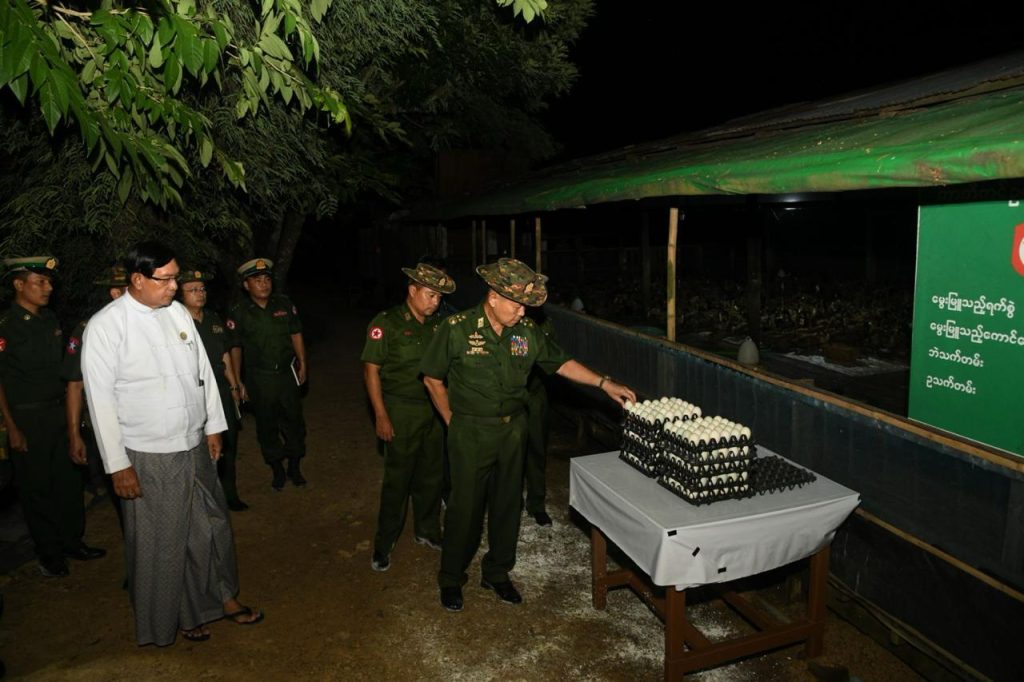
Then, the Vice-Senior General and party visited the Yangon Region Military Command’s No. 4 Agriculture and Livestock Camp. At the briefing hall, the regional commander presented updates on the agricultural and livestock breeding camps under the Regional Military Command, their implementation status in line with higher-level directives, and ongoing operations at these camps and farms and also reported on the availability of products such as meat, fish, veg-etables, eggs, and milk, which are being sold at affordable prices to officers, military families, retired personnel, police force members and their families, as well as local civilians. The Vice-Senior General emphasized the importance of ensuring that food products from these integrated agricultural/livestock farms are fresh and nutritious and said that the purpose of these integrated agriculture and livestock breeding farms is to supply affordable goods to not only military personnel but also government employees at prices lower than market rates. He stressed prioritizing afford-ability over profit, systematically feeding the livestock with proper animal feed, and preven-ting the spread of infectious diseases through proactive measures. He also advised that consul-tations be held with veterinary and livestock breeding experts to ensure that the products meet health standards. Efforts should continue until all military per-sonnel and their families under the Regional Military Command have sufficient access to food and plans should be developed and implemented systematically by phase and period to expand production further and to boost surplus production before making additional necessary in-structions.
Then, the Vice-Senior General and party inspected the dairy cattle at Agriculture and Live-stock Camp No. 4 and observed the operations at Camp No. 3, where Novogen Brown layer chickens, high-quality meat-producing pigs using an evapo-rative cooling system, and Khaki Campbell ducks are being bred, and gave necessary instructions to the responsible officials.